Category: Uncategorized
-

Emergency Appeal for Gaza
{mosimage} United Palestine Appeal has a campaign going for Gaza. Learn more here: -
AUPHR Business
The items in this section are reserved for AUPHR board members doing official AUPHR business.
-
Books by Edward Said
{APF Action=”ProductsInclude” ItemId=”0375725741,0679767258,0679739882,0679758909,0679761454,0231122640,0679750541,039474067X,0679730672″ locale=”us” DisplayNum=”9″}
-
Media Study of Oregonian News Coverage: Some lives are more equal than others . . .
Oregonian Biases Covering the Palestine / Israel conflict
Download the full report here: www.auphr.org/https://www.auphr.org/wp-content/uploads/2007/11/Oregonian_Report_04072005.pdf (Updated Version)
For the report in Arabic: www.auphr.org/https://www.auphr.org/wp-content/uploads/2007/11/OregonianCoverageArabic.pdf
PMWATCH – March 14, 2005 — A three-way collaborative effort between Americans United for Palestinian Human Rights — www.auphr.org — Palestine Media Watch — www.pmwatch.org — and If Americans Knew — www.ifamericansknew.org — has produced a new report focusing on the news coverage of the Palestinian-Israeli conflict by The Oregonian — www.oregonlive.com/news
The report details the findings on The Oregonian’s news coverage of the conflict between May 1, 2004 and October 30, 2004.
The Oregonian’s coverage was found to display clear double standards when it comes to reporting Palestinian deaths compared with Israeli deaths. The likelihood of a death receiving headline coverage clearly depended on the nationality of the person killed.
Analysis of The Oregonian news articles showed that 100% of all Israeli deaths were reported during the period of this analysis, and in many cases were reported more than once.
By contrast, only 61% of all Palestinian deaths were reported.
The Oregonian significantly under-reports Palestinian deaths compared to Israeli deaths
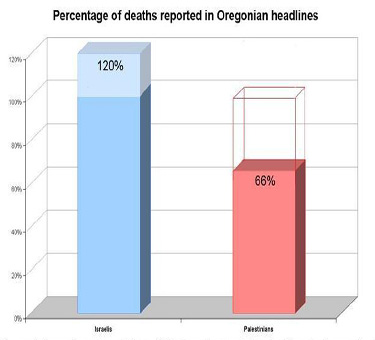
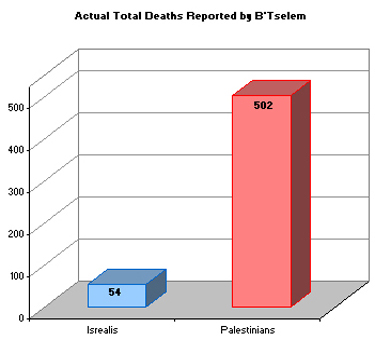
These graphs shows that that 502 Palestinians and 54 Israelis were killed during the study period according to B’Tselem. Of these 120% of all Israeli deaths and 66% of all Palestinian deaths were headlined in The Oregonian.
Even more disturbing was the coverage of children’s deaths, with only 28% of Palestinian children’s deaths receiving any coverage by the Oregonian, compared with 100% coverage for Israeli children.
The Oregonian dramatically under-reports the death of Palestinian children
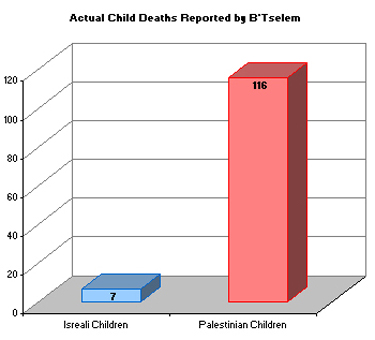
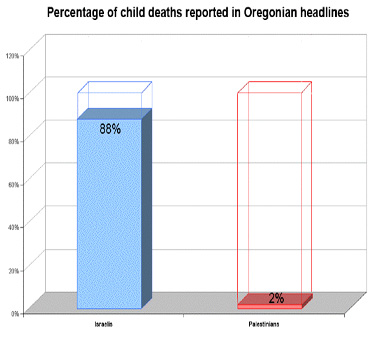
These graphs shows that that 116 Palestinian children and 7 Israeli children were killed during the study period according to B’Tselem. Of these 88% of all Israeli deaths and only 2% of all Palestinian deaths were headlined in The Oregonian.
According to the Israeli Information Center for Human Rights in the Occupied Territories, B’Tselem — www.btselem.org — a total of 54 Israelis and 502 Palestinians were killed in Israel and the occupied Palestinian territories during this period. For the full report, please see: www.auphr.org/https://www.auphr.org/wp-content/uploads/2007/11/Oregonian_Report_04072005.pdf (Updated Version)
The Newspaper Association of America ranks The Oregonian 20th among the daily papers in the United States, with a daily circulation of 337,707.
Please spare a moment to share your thoughts on these findings withe Oregonian. A quick phone call to the Oregonian, or even a small letter, from you expressing your views on these findings will help a great deal in our struggle, one battle at a time, for more humane and more informative coverage of the conflict.
You can share your feedback with The Oregonian via: Telephone: (503) 221-8434
Email: letters@news.oregonian.comPlease do feel free to share with us your letters or a summary of your conversation with the Oregonian at
info@pmwatch.org.
Palestine Media Watch (866) DIAL-PMW
www.pmwatch.orgTo contact Americans United for Palestinian Human Rights: info@auphr.org
(503) 287-1885Executive Summary of Report
This six-month study consists of a statistical examination of The Oregonian’s news coverage of the Israeli-Palestinian conflict from May 2004 through October 2004. The categories examined were coverage of deaths in general, particularly children’s deaths. We chose criteria for measuring accuracy that would be universally acknowledged as significant, could not be construed as subjective, and could be independently verified. For our control numbers we used The Israeli Information Center for Human Rights in the Occupied Territories (B’Tselem). B’Tselem monitors human rights violations in the Occupied Palestinian Territories of the West Bank, East Jerusalem, and the Gaza Strip (http://www.btselem.org).
Our findings indicate The Oregonian could improve the accuracy of their news reporting. We found a disparity in the likelihood of a death receiving headline coverage based on the nationality of the person killed. This discrepancy was even more pronounced in The Oregonian’s coverage of the killing of children. The same pattern was seen in the body of the articles.
During the study period of May 2004 through October 2004, B’Tselem found a total of 54 Israelis were killed in Israel and the occupied Palestinian territories. Of these, 57 % were soldiers, 29% were adult civilians and 14% were children. In the same period, a total of 502 Palestinians were killed in the occupied Palestinian territories. Of these, 43% were combatants, 34% were adult civilians, and 23% were children (B’Tselem). Overall, during the period over 10 times more Palestinians were killed than Israelis. Palestinian children were killed at a rate 15 times that of Israeli children. Analysis of The Oregonian news articles indicate that 100% of all Israelis deaths were reported and 120% were highlighted in news headlines. (Results over 100% indicate that individual deaths were reported multiple times.) By contrast, 61% of all Palestinian deaths were reported in news articles and 66% in news headlines.
When looking at the coverage of children’s deaths, The Oregonian reported 100% of Israeli children’s deaths in news articles and 100% in news headlines, while 28% of Palestinian children’s deaths received coverage in news articles and 2% received headlines. In The Oregonian’s cumulative totals of those killed from May 2004 through October 2004, only 4 of 130 news stories contained cumulative totals of deaths on both sides somewhere in the article.
We are providing this report to The Oregonian to raise editor awareness of inaccuracies in coverage of the news. We are also providing this study to the public to help them evaluate The Oregonian as a source for understanding the Israel/Palestine conflict.
-
Media Study of Oregonian Editorial Coverage
Oregonian Exclusions Covering the Palestine / Israel conflict
“on probably the most enduring and insistent foreign policy issue of our time, we routinely do not hear from one side” — Don Wycliff, Chicago Tribune
See also: AUPHR’s report on the Oregonian’s news coverage
Download the full editorial report here: www.auphr.org/https://www.auphr.org/wp-content/uploads/2007/11/OregonianEditorialReport.pdf
I. Executive Summary
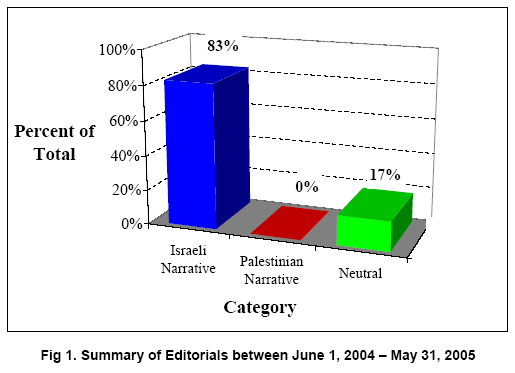
As the only daily newspaper in the State of Oregon with state-wide circulation and the largest newspaper in the Pacific Northwest, the Opinion Page editors of The Oregonian carry the burden of a public trust to provide a wide-open forum for debate on the pressing issues of our day. With respect to the debate on the Israeli- Palestinian conflict, however, the editors of the Opinion Pages have failed to meet their obligations to the public. This report documents the findings of a one-year study of the Opinion Pages of The Oregonian conducted by Americans United for Palestinian Human Rights and Palestine Media Watch. Specifically, this report is concerned with the content presented in The Oregonian’s Editorial Section and the newspaper’s selection of commentaries, cartoons, and letters to the editor dealing with the Israeli-Palestinian conflict for the period beginning on June 1, 2004 and ending on May 31, 2005.
The quantitative part of this study was performed using the Content Analysis methodology. The method was used to select and classify the editorials, op-eds, letters, and cartoons that were related to the Israeli-Palestinian conflict into three classes or narratives. The three general narratives under which each item was classified were the Israeli-narrative, Palestinian-narrative and the Neutral-narrative. Also presented is a qualitative assessment in the form of two in-depth case studies for the months of June and July of 2005.
Among the study’s key findings are the following:
- 83 percent of all published editorials on this issue reflected an Israeli-narrative with 0 percent of editorials reflecting the Palestinian-narrative.
- With respect to commentaries or op-eds, 56 percent promoted the Israeli- narrative while only 4 percent exhibited attributes of a Palestinian-narrative.
- The majority of cartoons, 62 percent, represented attributes of an Israeli- narrative, while 38 percent exhibited attributes of a Palestinian-narrative.
- Most editorial space and selected commentaries dealing with the Israeli- Palestinian conflict largely present the Israeli-narrative and rarely debate the illegal and immoral nature of Israel’s actions.
- The Oregonian has seriously constrained the nature and range of voices available to readers on the Israeli-Palestinian conflict. There is also a noted failure to respond or react to news items indicating Israel’s gross violation of Palestinian human rights and its noncompliance with international law.
- The Cartoon Section was tilted to the Israeli-narrative and complimented the content of the Editorial and Commentary sections of The Oregonian in reinforcing this view. The Letters to the Editor Section, though more representative of a Palestinian-narrative, is, by its nature, an insufficient counterbalance to the Israeli-narrative presented regularly in the other sections of The Oregonian’s Opinion Pages.
Over an extended period of time, one would have expected to find balance in the treatment of the Israeli-Palestinian conflict in the Opinion Pages of The Oregonian. Like the news sections of the newspaper, the material presented in the Opinion Pages should also meet basic journalistic standards of balance, fairness and accuracy. Rather than make the newspaper a forum where the Israeli-Palestinian conflict might be debated and discussed, however, little in the Opinion Pages has deviated from the official Israeli government positions. This is reflected in what is or is not discussed, the timing of the issues presented in the editorials and commentaries, and how those issues are framed.
The results of this one-year study demonstrate that the hypothesis that The Oregonian Opinion Pages provide a wide-open forum for debate is false. In fact, the editorial and commentary sections of The Oregonian very seldom provided an opportunity for readers to be exposed to a Palestinian-narrative of the Israeli- Palestinian conflict or to a neutral human-rights centered perspective.
The Oregonian has largely excluded voices coming from the Palestinian-narrative from the discussion of current events on this conflict. Discussion of international human rights, humanitarian law and violations of the same were also largely left out. The result is that the newspaper has narrowly defined the arguments that are allowed to participate in this debate. The systematic over-representation of the Israeli-narrative and significant silence about important issues, such as international laws and humanitarian norms, raises serious questions about The Oregonian’s commitment to journalistic standards for balance, fairness and accuracy.
-

Support Palestinian Fair Trade Products
One great way to keep Palestinians on their land’ is to buy Palestinian. Canaan Fair Trade is a Palestinian organization that sells certified organic extra virgin olive oil made in the traditional manner in the West Bank – the land where olive oil began. Activism never tasted so good! Click the logo below to go to the Canaan Fair Trade Store .
Canaan Fair Trade guarantees a fair price to farmers and producers, including an Organic premium. They require that farm workers and workers at the processing points, like presses and mills, are paid fairly and provided with healthy and safe working conditions set by the Palestine Fair Trade Association (PFTA) guidelines. (Learn more about PFTA at www.palestinefairtrade.org).
Your Canaan Fair Trade order supports these projects in Palestine:
Trees for Life – A Project to Plant Thousands of Olive Trees in Palestine
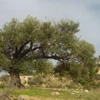 This project helps offset the enormous destruction of trees in Palestine by the Israeli army, Israeli settlers, and the Israeli segregation wall, and helps keep Palestinians on their land. Trees for Life provides individual Palestinian farmers with 25 to 50 new olive tree seedlings (3 years old) to plant and nurture in order to renew their decimated groves. Priority is given to small farmers, farmers that have lost trees to the Israeli destruction, women who own land and are interested in farming, and young farmers. Last year, 15,000 trees were planted. For every tin of olive oil sold, one dollar goes to Trees for Life.
Canaan Scholarship Fund
 Access to education is a major concern in Palestine. Some 20,000 students have been affected by the construction of the Israeli “Wall.” Palestinian schools have been closed for months at a time. An estimated 64% percent of people in the West Bank live below the poverty line. Canaan Fair Trade is committed to increasing access to higher education especially for Palestinian farm and refugee communities. This year ten scholarships were awarded to high school graduates. Priority was given to students whose parents never attended university. Students attend the university and degree program of their choice. Scholarships cover the cost of tuition for four years of study. For every tin of olive oil sold, one dollar goes to Canaan Scholarship Fund.
Micro-Loans for Women
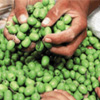 The Micro-loan Project enables small producers, and people with few resources, especially women, to start their own business and become self-supporting. Two-year micro-loans of $500 to $1500 are used to purchase supplies and begin producing according to fair trade guidelines. Canaan Fair Trade insures success by providing specific production methods, quality specifications and proper training, then marketing the products produced. Currently there are four women-owned cooperatives of 21 members producing Couscous and Za’atar, and four women cooperatives of 20 members producing sun-dried tomatoes. You can join Canaan Fair Trade in the Micro-loan project by purchasing olive oil or make a micro-loan donation to the program of your choice.
 -
Factsheets
In this section of our website we will try to compile a list of Factsheets to and Frequently asked Questions resources regarding the Palestinian struggle for justice. Please select your choice from the menu on the left.
If you have a resource that you think would be of use to other readers, you may email the link information to our webteam
- Refugees
- Boycott, Divestment, and Sanctions (BDS)
- The Wall
- Oregonian Editorials
- Oregonian News Coverage
-
Books about Palestine
{APF Action=”ProductsInclude” ItemId=”0805057404,0521009677,0679739882,1851685553,0743285026,0807003093,1844670767,1430309865,0521683157,156097432X,1931859442″ locale=”us” DisplayNum=”10″}