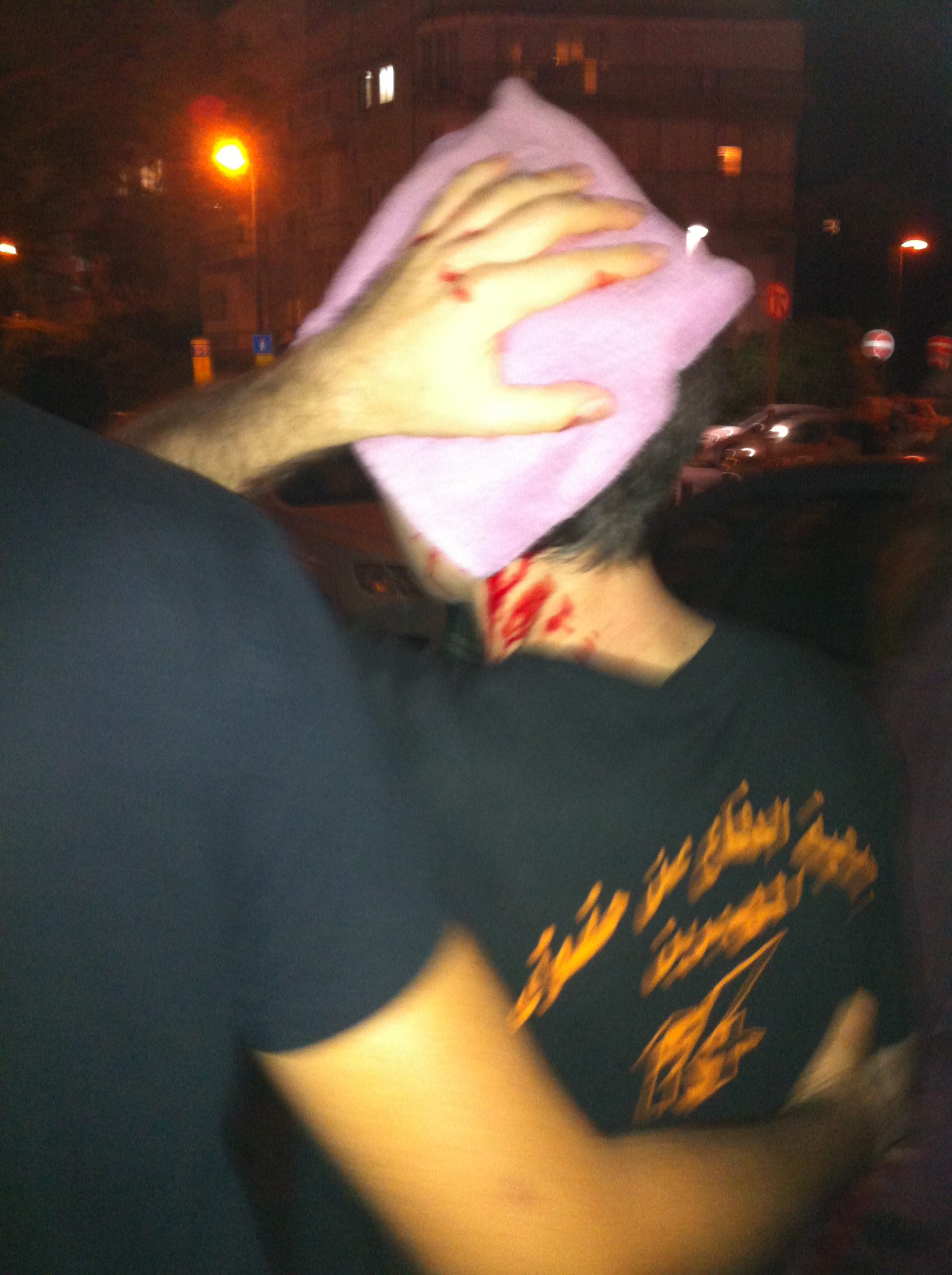
Survivors of massacre in Khuza’a say Israeli forces used Palestinians as human shields
Yousef Alhelou on July 26, 2014
Khuza’a is a village in the very eastern part
of Khan Younis adjacent to the border fence in the southern Gaza strip.
Its farmers have faced death almost on a daily basis in the past 7
years as Israeli gunfire has become the norm along the buffer zone
between Gaza and Israel.
Following the Shuja’iyeh massacre,
Israeli forces invaded Khuza’a with aerial strikes targeting any moving
object. Survivors recall with horror that seemingly heavy random tank
fire led to the killing of dozens, injuring dozens others.
Over 150 of its residents were arrested by
Israeli forces. Most of them were released, others are still in
detention. Rescue calls were made live on the local radio stations, as
many residents were besieged in their homes, unable to leave. Those who
managed to leave came under fire as they were fleeing.
Ayman Abu Toaimah, 32, a resident of
Khuza’a recalls, “As Israeli invading troops advanced to the village
they besieged it and used residents as human shields. When the Israeli
army arrested people and then released some of them, they were told they
are free to go back to the village, but as they were fleeing they came
under fire and some of them shot dead. These people were used as human
shields.”
Abu Saleem, 56, a resident of
Khuza’a echoed Abu Toaimah, “Israelis claim that Hamas is using us as
human shields– how? This is a lie, we do not see fighters in the
streets. It’s them, the Israelis who used us as human shields in Khuza’a
and Shuja’iyeh. They turned our
houses into military posts, terrified residents in the houses. They
attacked innocent civilians with their bombs, and missiles, they
attacked chicken farms, they burned our crops, they have no mercy.”
What happened in Khuza’a was a massacre.
Civilians were killed in their homes and while they were fleeing. Even
ambulances were not immune. Paramedics report that Israeli forces
stopped ambulances that were trying to reach casualties and tried to
arrest a number of wounded. Ambulances came under fire despite the
coordination by the International Committee of the Red Cross (ICRC).
Scenes of dead bodies scattered in the streets reminiscent of the Sabra
and Shatila massacre that took place in two Palestinian refugee camps in
1982 have begun to leak out of the village.
Abu Ali Qudail a resident of Khuza’a said:
“When the ICRC told us that ambulances are waiting us at the entrance of
the village from the western side, about 1,000 people rushed to leave
their homes, some of which were used as a hideout for Israeli forces. As
people were leaving they were surprised that the ambulances were not
there, and as we were waiting tank shells rained down on our heads.”
Many people were killed, many others injured.
Survivors say they could not help the wounded, many were still under
the rubble, homes were destroyed and the smell of smoke and bombs was
everywhere.
Abu Ali Qudail continued: “I was watching
members of my family dying in front of me, some of them were torn to
pieces. Rami, Ibrahim, Alia, Haj Abed died..we had to leave them behind,
as soon as we reached one of the Khan Younis schools we entered it to
seek shelter but it was very crowded with people who fled their homes.
It’s hard to see people dying and you do not know what to do. One of my
relatives’ homes were struck while they were inside.”
As the all-out Israeli assault on Gaza
entered its 19th day, John Kerry announced from Cairo that he proposed a
one week ceasefire, but Israel’s PM Netanyahu refused the offer and
only agreed to a 12-hour lull.
Ma’an News reports
on one family that fled Khuza’a and was then killed by an Israeli
missile strike in Khan Younis as the ceasefire went into effect:
Minutes before a 12-hour humanitarian ceasefire went into
effect in Gaza on Saturday morning, an Israeli airstrike left at least
20 members of a Palestinian family dead in Khan Younis refugee camp.
The al-Najjar family had fled their homes in Khuzaa, just east of
Khan Younis, earlier in the day after Israeli artillery shelling there
killed dozens, and they were hoping to find shelter somewhere further
from the border.
Their refuge in Khan Younis, however, turned out to be anything but,
as missiles fired from Israeli warplanes just before 8 a.m. completely
leveled the four-story building they were sleeping in.
The airstrike killed eleven children, four women, and five men from the family, according to Palestinian medical sources.
The killing of the al-Najjar family brought the death toll in Gaza since the beginning of hostilities 18 days ago to 940.
Following the attack on the UN school in Beit Hanoun in northern Gaza
in which 17 people were killed and over 200 injured, 29 of the UN Human
Rights Council’s 47 members voted in favor of creating a commission of
inquiry to look at possible war crimes committed by Israel. Only the
United States voted against the resolution, while 17 states abstained,
10 of them European.
The vote was taken after Navi Pillay, the UN’s human rights
commissioner, said “there seems to be a strong possibility that
international law has been violated, in a manner that could amount to
war crimes.”